
AIRY compared to other systems
What exactly is the difference compared to normal flower pots or technical devices?
We are repeatedly asked, what exactly is the difference between AIRY systems compared to a normal flower pot or technical devices?
Here is a brief overview.
AIRY vs. plants in normal pots
Normal plant pots come with some challenges: The plant "roots through" until it finds no more space in the pot. This requires increased care and makes later repotting necessary. Ventilation of the root system generally does not take place, so the plant's existing capacity for indoor air purification is hardly utilized. Additionally, there is the ongoing risk that the plant receives too little or too much water.

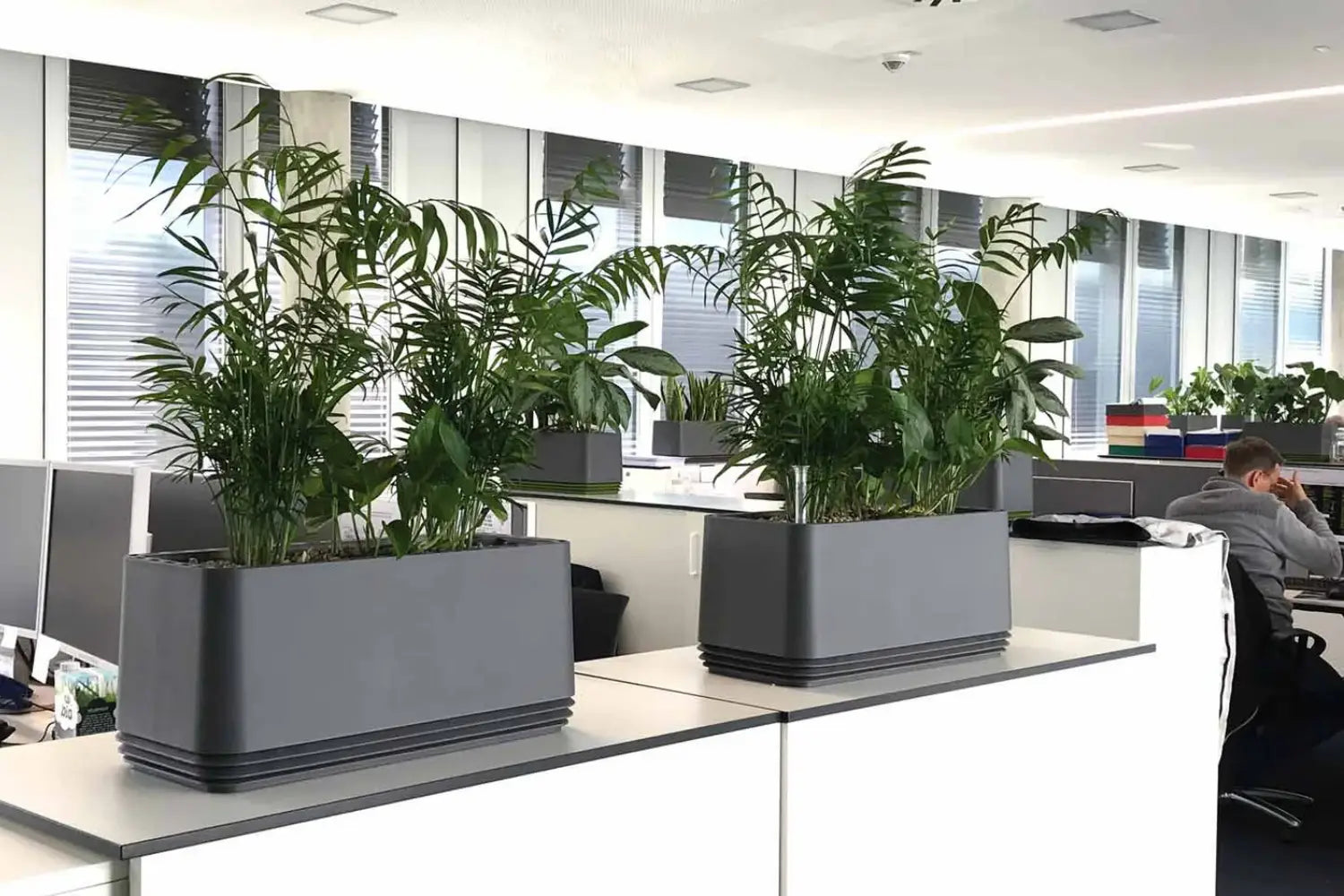
AIRY is clearly superior to conventional plant pots in all these aspects and also recognizable to laypeople: The design of the inner grid pot ensures, for example, that the plant roots stop growing as soon as they no longer feel resistance ("air pruning"). This happens the moment they reach the slots of the grid. While the plant's root hairs are continuously ventilated through the AIRY system, the water-conducting roots can optimally supply themselves through the existing tank. A growth comparison over 150 days also showed that plants in an AIRY system develop about half more biomass than the comparison plants in a conventional pot.
AIRY vs. HEPA Filters
AIRY removes Volatile Organic Compounds (VOCs) from indoor air. VOCs are among the most dangerous pollutants. A HEPA filter alone is not capable of this; it must be equipped with activated carbon. Even then, its performance is significantly lower.
While AIRY becomes more powerful over time as the plant and the microbes in the soil substrate adapt to their environment, the effect of a HEPA filter diminishes until it is replaced. This refresh should happen at least once a year, is laborious and expensive.
AIRY, on the other hand, only needs daylight and a little water regularly. No energy is consumed and no waste is produced.
AIRY vs. Electronic Filters
The efficiency of electronic filters decreases as soon as the filter fills with particles, the airflow diminishes, or is irregular.
In contrast, AIRY is completely independent of technical irregularities – and AIRY's air-purifying effect even increases over time. This is because the plant and the microbes in the soil substrate adapt to their environment.
An electronic filter requires regular maintenance and cleaning. This is time-consuming and directly exposes the user to the collected dirt.
AIRY, on the other hand, requires no maintenance. A little water every few weeks and possibly some nutrient supplement for the plant is completely sufficient.
Last but not least: An electronic filter is an electronic device with the appearance and requirements of a household appliance (power supply). AIRY, on the other hand, with its plant, is a natural addition to interior design. And often a single plant alone makes the difference.
AIRY vs. Ion Air Purifiers
Powerful ion air purifiers, like all other technical air purifiers, are expensive. In addition, they emit ozone, which can cause problems with the breathing air. Furthermore, these devices tend to contaminate household surfaces with fine pollutant particles that are difficult to remove.
AIRY is gentle and does not cause these problems.
AIRY vs. Ozone Air Purifiers
Ozone is one of the strongest sterilizing agents and highly effective against germs, bacteria, and odors. However, no devices are available for private users that are allowed to use ozone strongly enough, because ozone is a gas that causes significant irritation and respiratory problems.
These devices also have the problem of surface contamination by fine pollutant particles that are difficult to clean.
AIRY is gentle and does not cause these problems.

The author: Peer-Arne Böttcher
Peer is the founder of AIRY and passionate about the topic of healthy indoor air. For many years, he has been intensively engaged with the scientific foundations and technical possibilities of how our breathing air can be sustainably improved – completely without chemicals, filters, or electricity.